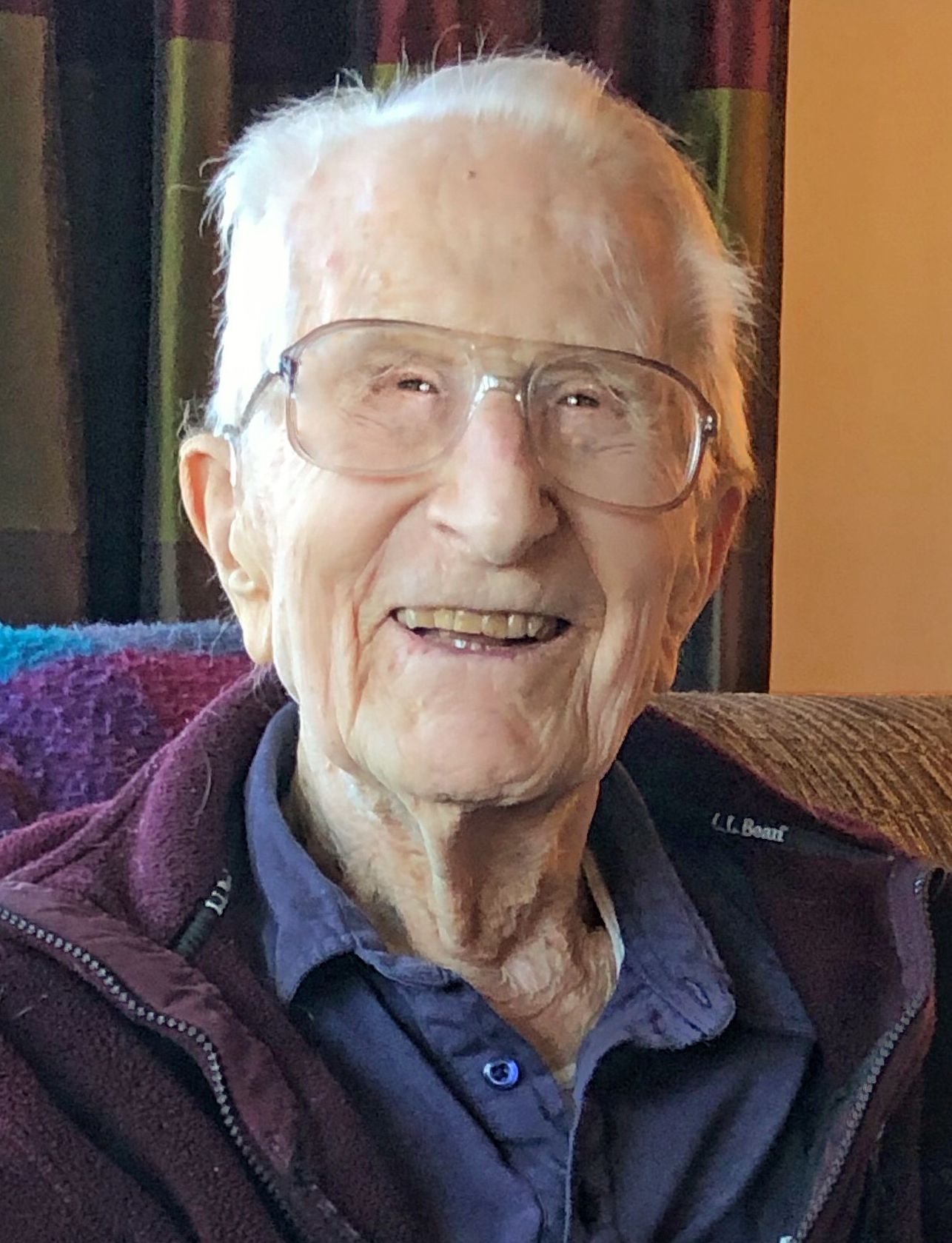
Max William Carbon
January 19, 1922 - June 23, 2021
Obituary
MIDDLETON - Max William Carbon, age 99, of Middleton, Wis., passed away on Wednesday, June 23, 2021, at his home. He was born in Monon, Ind., the son of Joseph William and Mary Olive (Goble) Carbon on Jan. 19, 1922. Meeting on a blind date, he married Phyllis Camille Myers on April 13, 1944, his bride of 76 years. She preceded him in death by one year. He was also preceded in death by his brothers, Clarence and Harry; his sister, Doris Hamilton; and grandson, Quintin Berkson. His survivors include his sons, Ronald Carbon and David Carbon (Danhong Chen); his daughters, Jean Dabel (John), Susan Carbon (Larry Berkson) and Janet Corradini (Michael); 12 grandchildren; and 12 great-grandchildren.
Carbon attended Purdue University, where he earned his bachelor’s degree in mechanical engineering in August 1943. After completing his undergraduate education, he joined the U.S. Army in 1943 as a corporal, and served in the ordnance department in New Guinea, the Philippines and Japan. He retired to the U.S. Army Reserve in 1946 as a captain.
Following World War II, Carbon returned to Purdue to earn his master’s degree in 1947 and Ph.D. in 1949. While a graduate student, he held the DuPont Fellowship in mechanical engineering.
From February 1949 until September 1955, he worked at the General Electric Company’s Hanford Works in Richland, Wash., producing plutonium for atomic and hydrogen bombs used for national defense. His primary duty was as head of the heat transfer group, which was responsible for the safety analysis, operating limits, and cooling technology that allowed for increased plutonium production and extended reactor lifetimes. As group head, he played a significant role in increasing production by a factor of four over design. Subsequently, he joined the Avco Manufacturing Corp. as head of its thermodynamics section, successfully designing the nose cone for the Titan Intercontinental Ballistic Missile.
In 1958, he came to the University of Wisconsin-Madison to establish a nuclear engineering program as part of a growing postwar research emphasis on designing better, more efficient nuclear power plants for generating electricity. In 1961, as the program grew, he became first chair of the Department of Nuclear Engineering; at second or third, its academic programs in nuclear engineering consistently ranked among the nation’s highest. During his tenure as chair, he led the department in establishing bachelor’s, master’s, and Ph.D. curricula, and he strongly supported the practice of “research teaching” (in which students learn research techniques and methods and how to study and work independently of an advisor) as a necessary complement to formal classroom instruction. He was one of the key advisors for undergraduates in nuclear engineering, and supervised more than a dozen master’s and Ph.D. students.
Carbon took great pride, and saw it as a critical component of his department chair responsibilities, in recruiting, hiring, and mentoring top faculty and staff, many of whom ultimately were named fellows of the National Academy of Engineering. Carbon also oversaw construction of the university’s research and training nuclear reactor, which achieved initial criticality in early 1961. He served as chair for 34 years until his retirement in 1992, as the department added plasma physics and engineering mechanics components to become today’s Department of Engineering Physics. He was thereafter named Professor Emeritus.
As a faculty member, Carbon helped to define, advance and champion the field of reactor safety and heat transfer, not only among the technical community, but also by educating members of the public about the importance of nuclear power. He headed a Ford Foundation project in Singapore from 1967 to 1968 aimed at developing engineering education programs at the college level and, in 1997, he authored the book, “Nuclear Power: Villain or Victim? Our Most Misunderstood Source of Electricity.” Written for nontechnical audiences, the book sets forth the benefits and risks of nuclear power. Now is in its fifth printing, it has been translated into three other languages.
Carbon’s many honors include being named to Who’s Who in America in 1964. He was named a fellow of the American Nuclear Society in 1975 and was elected to the National Academy of Engineering in 2012 for his pioneering work in establishing engineering educational programs for nuclear reactor design and safety. He served on the Nuclear Regulatory Commission’s Advisory Committee on Reactor Safeguards for eight years and consulted for the nuclear power industry in several capacities throughout his career.
On the lighter side, Max enjoyed countless fishing trips to Canada and Alaska with friends and family members. Walleye and salmon were favorites. He and his wife, Phyllis, traveled the world extensively, and were especially fond of Australia, New Zealand, and countries in Asia. As they got older, they continued to enjoy their annual vacations in Costa Rica (but not until after the Super Bowl game) and on the coast of Maine, eating lobster, blueberry muffins, and strawberry pies and listening to crashing waves. Max and Phyllis were champion bridge and duplicate bridge players, and he enjoyed cards of any sort with anyone bold enough to challenge him. He won the last game of rummy he ever played the day before he passed away.
Friends are invited to a service of remembrance to be held at BLACKHAWK COUNTRY CLUB, 3606 Blackhawk Drive, Madison, Wis., at 1 p.m. on Sunday, Aug. 15, 2021.
In lieu of flowers, memorial donations may be sent to the UW Foundation for the Max Carbon Fund in the Engineering Physics Department, Agrace HospiceCare, or a charity of your choice. Online condolences may be made at www.gundersonfh.com.
Gunderson West
Funeral & Cremation Care
7435 University Ave.
(608) 831-6761
Events
Memorial Service
Sun Aug 15, 2021 @ 1:00 PM CDT
Blackhawk Country Club • 3603 Blackhawk Drive, Madison, WI 53705
Photos
No photos of Max have been shared yet.
Memories
RC
R. J. Cashwell
Other •
Marilyn and I wish comfort to you in your time of sorrow. Max was a remarkable man, and a mentor to me as I worked at UW. I respected him for his knowledge and for his concern for the department, staff, and students. I remember fondly my interview in 1962 when he said, in view of the places where I had lived, "Do you know that it gets cold in Wisconsin in the winter?"
GE
Gil and Nancy Emmert
Other •
Max was a great department chair, and a tough act to follow.
SB
Samit K. Bhattacharyya
Other •
I was a Graduate Student in the Department of Nuclear Engineering at the University of Wisconsin, Madison during 1969 -1973, when Max was Department Chair. The Department at the time was a thriving, invigorating, growing place under his chairmanship, and I learned a lot, and enjoyed my time there. I have many memories of Max , all positive, from his classroom teaching, his interest in graduate student research, his firm but considerate administrative actions, his regular jogging (even in the coldest of days!), etc etc. I remember how Max and Phyllis generously shared their Thanksgiving time with me me and other foreign students at their house. He communicated with me after I had graduated and moved on, keeping me informed of progress in the Department, asking for suggestions and generally inquiring about my well-being. I last saw him at a lunch reception in 2009 in Madison, where he complimented me on my career successes and laughed hard at my jokes (a sign of his great perception and wit!). Through his work Max certainly left his mark on the Department at Wisconsin and the Nuclear Technology field. RIP Professor Carbon. Samit K. Bhattacharyya, Ph.D., P.E.